Iran negotiation team travels to Qatar to continue diplomacy
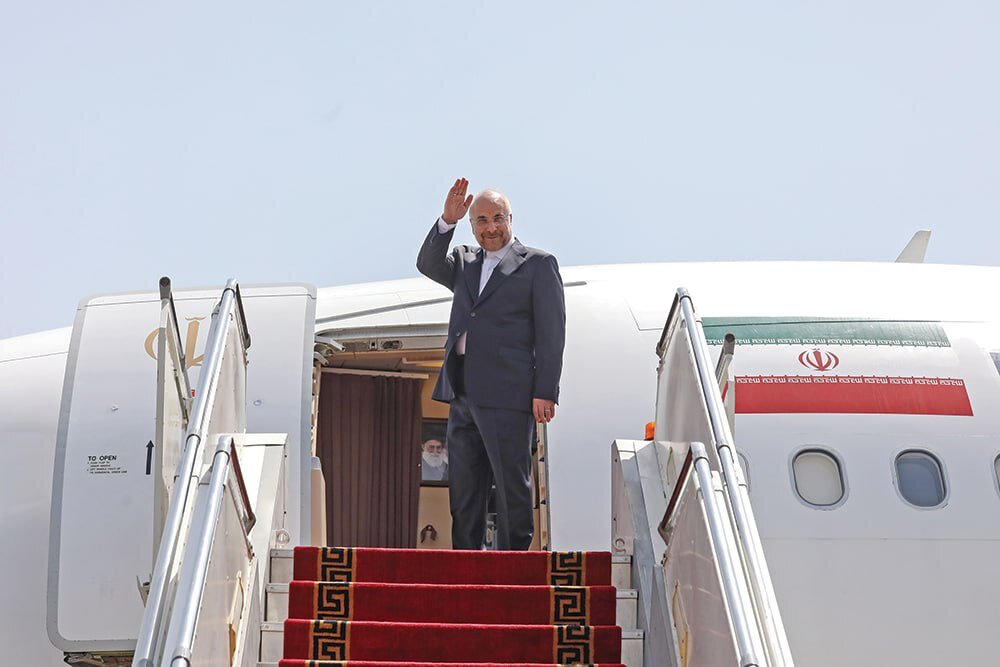
TEHRAN - A high-ranking Iranian delegation headed by Parliament Speaker and top negotiator Mohammad Baqer Qalibaf travelled to Qatar on Monday afternoon amid increasing mediation efforts to bring a permanent end to the joint US-Israel war that began on February 28.
Foreign Minister Abbas Araghchi and Central Bank Governor Abdolnaser Hemmati were among the delegation members to discuss the process of finalizing a memorandum of understanding (MoU) between Tehran and Washington.
The presence of the Central Bank chief is significant, as Iran has stressed that the immediate release of $12 billion in frozen assets held in Qatar is a precondition for signing the MoU.
Iran’s Foreign Ministry spokesperson said in his weekly press briefing on Monday that conclusions have been reached on many topics discussed in the potential MoU. However, he stressed that this does not mean Tehran is close to signing an agreement.
“It is correct to say that we have reached a conclusion on a large portion of the issues under discussion. But to say that this means the signing of an agreement is imminent — no one can make such a claim,” Esmaeil Baghaei, who was also recently appointed as spokesperson for Iran’s negotiating team with the US, said.
Baghaei stressed that any deal with the United States must include recognition of Iran’s rights over the management of the Strait of Hormuz and an end to Israeli strikes in Lebanon.
In the briefing, he also said that no nuclear issues would be included in the memorandum, except for a commitment to further negotiations within the next 60 days.
Iran has reiterated that it will not transfer its stockpile of highly enriched uranium to a third country and that domestic uranium enrichment remains a red line. President Donald Trump and Israeli Prime Minister Benjamin Netanyahu, meanwhile, have demanded that Iran dispose of its stockpile of highly enriched uranium.
Overall, Iran’s main conditions for ending the conflict include the lifting of sanctions, the release of frozen assets, compensation for damage caused by the US and Israeli war, recognition of Iran’s sovereignty over the Strait of Hormuz, an end to Israeli strikes in Lebanon, and the lifting of the US naval blockade of Iranian ports.
The US imposed the naval blockade after Pakistan-mediated talks between Iran and the US in Islamabad on April 11 ended without a breakthrough due to what Tehran calls the US excessive demands. The talks followed the April 8 ceasefire that paused 39 days of war.
Following the failure of the Islamabad talks, Pakistan has intensified its mediation efforts.
On Saturday, Pakistan’s Chief of Defense Forces, Field Marshal Syed Asim Munir, made his second visit to Tehran since the ceasefire and held talks with senior officials to advance the peace process.
Munir, who has been at the center of mediation efforts between Washington and Tehran, along with Pakistani Prime Minister Shehbaz Sharif, also held talks with Chinese President Xi Jinping in Beijing on Monday.
In his meeting with Sharif, Xi said he appreciated Islamabad’s “constructive role in mediating peace in the Middle East.”
China has also made efforts to help end the war on Iran. President Xi unveiled a four-point peace proposal for the Middle East in mid-April, emphasizing peaceful coexistence, respect for sovereignty, adherence to international law, and coordination of development and security. Iran has endorsed the Chinese plan.
The Iranian Foreign Ministry spokesperson also praised China’s four-point plan as a “valuable proposal,” describing China’s role in promoting regional peace and stability as “very constructive and useful.”
Qatar and Oman have also made efforts to bridge the gap between Tehran and Washington. However, Trump’s inconsistency, which is believed to be influenced by Netanyahu, has undermined the prospects for a lasting truce.
During 39 days of war, the US and Israel not only bombed Iran’s military sites but also residential areas and energy infrastructure, killing thousands of people. Iran, in response, carried out 100 waves of missile and drone strikes on Israel and American bases in the region. The military and economic cost of the war pushed Trump to accept a ceasefire with Iran.
Trump initially agreed to Iran’s conditions but has since continued to shift the goalposts.
In addition to his contradictory statements, Trump said on Monday that it should be “mandatory” for certain countries in the region — Saudi Arabia, Qatar, Egypt, Jordan, Turkey, and Pakistan — to sign up to the Abraham Accords as part of US efforts to reach a broader deal with Iran.
Such comments leave little doubt that Israel is pulling the strings of US foreign policy in the West Asia region.
Leave a Comment